
Why Does It Matter?
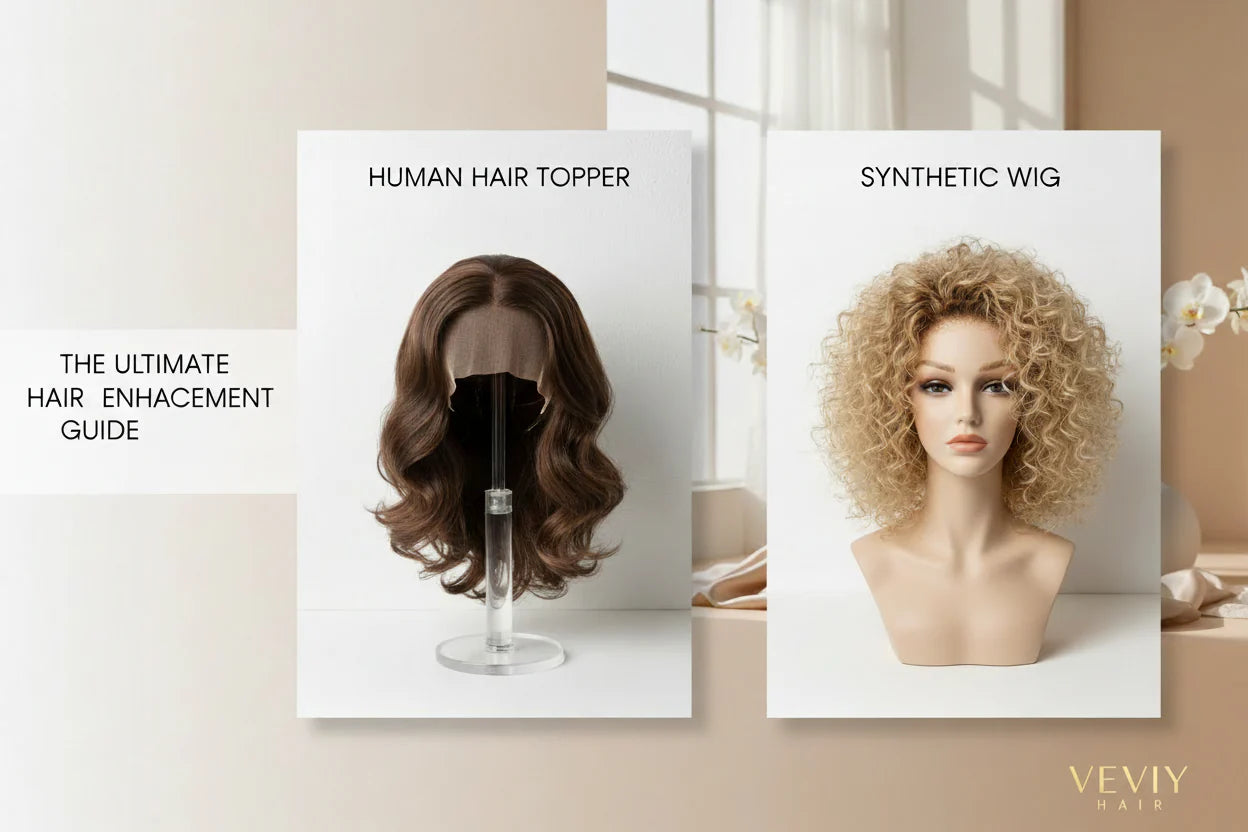
When shopping for hair toppers, wigs, or hairpieces, knowing the material is the first step to making a smart purchase. Human hair and synthetic fiber differ significantly in appearance, feel, lifespan, and care requirements. Here are 5 simple, reliable tests to help you tell them apart before you buy.
Test 1: Visual Inspection
Human Hair: Has a natural, soft sheen with subtle variation in strand thickness — just like hair that grows from your scalp. The luster shifts beautifully under different lighting.
Synthetic Fiber: Often appears overly shiny or plastic-like. The color tends to look too uniform, and under bright light it can look unnatural.
💡 Tip: Hold the strands up to natural daylight. Human hair has a warm, dimensional glow — synthetic fiber often looks "too perfect."

Test 2: Touch & Feel
Human Hair: Feels soft and silky, similar to your own hair. Running your fingers through it produces a slight, natural resistance — and no static.
Synthetic Fiber: May feel stiff or unnaturally slippery. It tends to generate static electricity and is more prone to tangling over time.
💡 Tip: In a dry environment, gently rub a few strands together. Noticeable static is a strong indicator of synthetic material.
Test 3: The Burn Test (Most Reliable)
This is the most definitive method. Please handle fire safely — only test a few strands away from flammable materials.
Human Hair burns like this:
- Curls and singes, producing a smell like burnt hair
- Leaves a soft, black powdery ash that crumbles easily
- Self-extinguishes when removed from the flame
Synthetic Fiber burns like this:
- Melts into a hard bead, producing a sharp plastic smell
- Leaves a hard, dark residue
- May continue to burn or drip
⚠️ Safety note: Only test a small sample in a safe, controlled environment away from flammable materials.

Test 4: Heat Styling Test
Human Hair: Tolerates heat styling tools (curling irons, flat irons) at 120°C–220°C. Styles hold naturally and the hair recovers well.
Synthetic Fiber: Standard synthetic fiber will melt, warp, or emit an odor when exposed to heat. Some "heat-resistant" or high-temperature fiber can tolerate moderate heat, but results and longevity still fall short of human hair.
💡 Tip: If a product is labeled "heat-friendly," confirm whether it's human hair or high-temp fiber — care instructions differ significantly.
Test 5: Water Test
Human Hair: Absorbs water, feels heavier when wet, and returns to its natural state when dry. It responds well to conditioner and moisturizing treatments.
Synthetic Fiber: Repels most hair care products. After washing, it may become frizzy or harder to manage. Frequent washing is generally not recommended.
Quick Comparison: Human Hair vs. Synthetic Fiber
| Feature | Human Hair | Synthetic Fiber |
|---|---|---|
| Sheen | Natural, dimensional | Overly shiny / plastic-like |
| Touch | Soft, silky | Stiff or unnaturally smooth |
| Burn smell | Burnt hair | Sharp plastic odor |
| Heat styling | ✅ Yes | ❌ Usually no |
| Lifespan | 1–3 years (with care) | 3–6 months |
| Price | Higher | Lower |
The VEVIY® Promise
Every hair topper and wig in our collection is crafted from 100% human hair, rigorously quality-tested to ensure the most natural look and comfortable wear. If you ever have questions about a product's material, our team is always here to help.

Laisser un commentaire
Ce site est protégé par hCaptcha, et la Politique de confidentialité et les Conditions de service de hCaptcha s’appliquent.